
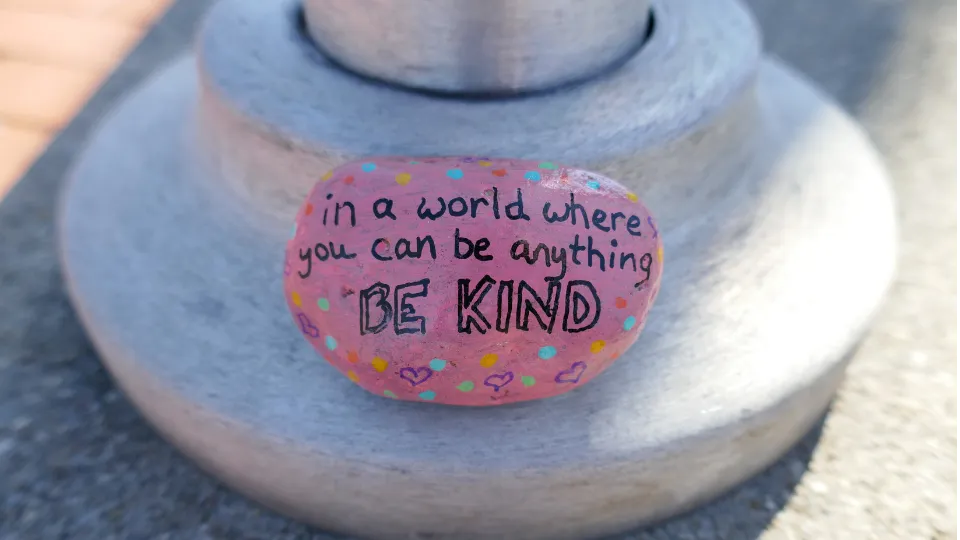
The Hidden Strength Behind Kindness - Kindness Series #2
Why compassion, boundaries, and self-respect require more courage than criticism
If someone described you as kind, would you take it as a compliment?
Most of us would say yes. And yet, many people secretly worry that being kind makes them vulnerable: too soft, too accommodating, too easy to take advantage of.
We admire kindness in others, but when it comes to ourselves, we often believe we need to be tougher, stronger, more guarded. Especially in a world that seems to reward confidence, assertiveness, and self-interest. But what if we've misunderstood kindness entirely? What if kindness isn't a sign of weakness at all?
What if it is one of the clearest expressions of inner strength?
Why We Often Mistake Toughness for Strength
Think about the messages we absorb every day: Stand your ground. Don't let people walk all over you. Look out for yourself. Never show weakness.
Many of these ideas contain some truth. Healthy boundaries matter. Self-respect matters. But somewhere along the way, strength became associated with hardness:
The ability to detach, to not care, to always appear unaffected.
Kindness, on the other hand, is often placed in a completely different category. Something nice to have, but not particularly powerful. Yet when you look closely, the opposite is often true.
It doesn't take much effort to criticize.
It doesn't take much courage to judge.
It doesn't take much awareness to react impulsively when someone upsets us.
Choosing kindness is often the harder path.

The Meeting That Changed Everything
A client once shared a story that has stayed with me.
They worked in a fast-paced corporate environment where deadlines were tight and stress levels were high. One morning, a colleague arrived late to an important team meeting. The reactions were immediate. People exchanged glances. Someone made a sarcastic comment. Others assumed they simply hadn't managed their time well.
My client felt the same irritation.
Then, during a break, my client learned that the colleague had spent most of the night at the hospital with their father. Suddenly, the story changed. The behavior hadn't changed. The facts hadn't changed. Only the understanding had changed. What struck them most wasn't that they had been wrong.
It was how quickly they had judged someone without knowing their reality.
We all do this.
We see a tiny fraction of another person's experience and build an entire story around it. Kindness asks us to pause before writing that story. Not because people should never be held accountable. But because we rarely know the whole picture.
Kindness Requires Awareness
Many people think kindness is something we do. In reality, it begins with something we notice. Most of us spend large parts of our day on autopilot.
We react to messages.
We react to traffic.
We react to difficult conversations.
Kindness becomes difficult when we're operating from constant reaction. Awareness creates space. And in that space, something important happens. We get to choose:
We can choose patience instead of irritation.
Curiosity instead of judgment.
Compassion instead of assumption.
That doesn't make us weak. It makes us conscious.

Being Kind Doesn't Mean Saying Yes
This is where many people get stuck. They hear words like compassion and kindness and immediately think of self-sacrifice. Always helping. Giving, putting others first.
What if: genuine kindness includes yourself, too?
In fact, kindness without boundaries often turns into resentment. We've all seen it. The person who constantly says yes. The person who takes on everyone's problems. The person who is always available. Eventually, exhaustion arrives. Not because they are kind.
But because they forgot to include themselves in that kindness.
Sometimes strength looks like helping. Sometimes strength looks like saying: "No, I can't do that."
Both require courage.
The Confidence Behind Compassion
There is a quiet confidence that comes with kindness. Not the loud kind that demands attention. Not the kind that needs approval. A deeper kind.
The confidence to act according to your values, even when it would be easier not to.
The confidence to remain respectful when others are not.
The confidence to choose understanding when judgment would be simpler.
The confidence to set a boundary without guilt.
The confidence to stay connected to who you want to be.
That kind of confidence isn't weakness.
It's self-leadership.
A Different Definition of Strength
Perhaps it's time to redefine what strength means. Maybe strength isn't about being the toughest person in the room. Maybe it isn't about winning every argument or proving every point.
Maybe strength is the ability to stay grounded in your values when life becomes challenging.
To stay compassionate without losing yourself.
To stay open without becoming naive.
To stay kind without abandoning your boundaries.
Because anyone can react. Anyone can criticize. Anyone can harden. But it takes real strength to choose your response. And that choice, repeated often enough, shapes the person you become.

Now, here's your chance to practice:
For the next couple of days, pay attention to the moments that test your patience: The difficult email. The slow driver. The colleague who frustrates you. The family member who pushes your buttons.
Before reacting, pause for a moment.
Ask yourself: "What might I not know about this situation?"
You don't need to excuse bad behavior.
You don't need to agree.
You simply create space for a different response.
And sometimes, that small pause is where kindness begins.
Key Takeaways
Kindness is not weakness—it is a form of inner strength.
Judgment is often automatic; compassion requires awareness.
Healthy boundaries are part of genuine kindness.
True strength is staying connected to your values under pressure.
Every act of kindness begins with a conscious choice.
Stay Tuned for More Kindness
This article is part of our Kindness Month series. If you have missed out on the Introduction, check this article (click here).
Next, we'll explore one of the most powerful ideas of all:
Why matching someone else's energy keeps us stuck—and how conscious responses can transform our relationships, our stress levels, and the way we experience everyday life - Article #3: Don't Match Their Energy
Subscribe to the newsletter to receive upcoming articles, reflections, and updates on the Kindness Challenge directly in your inbox.